

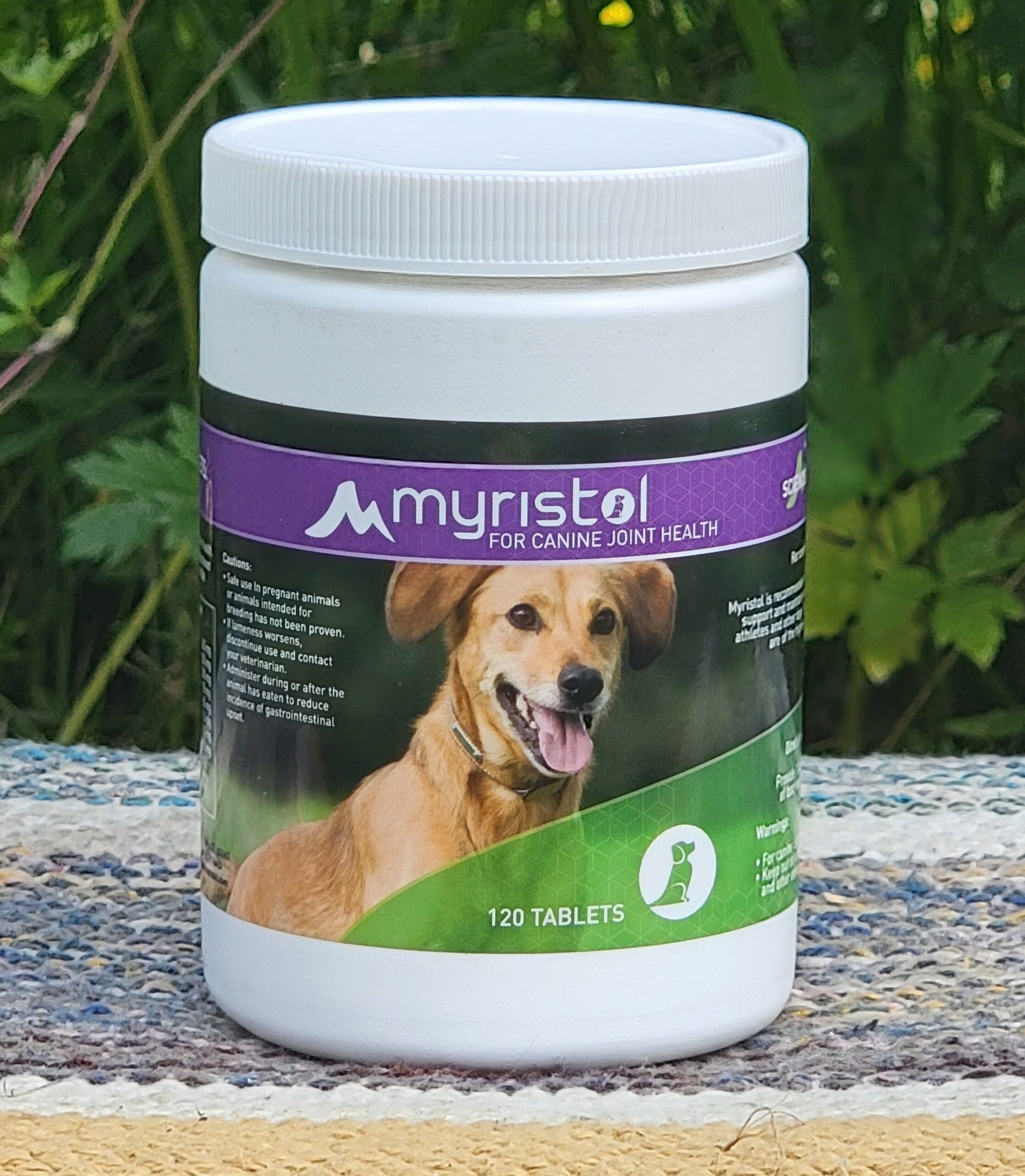
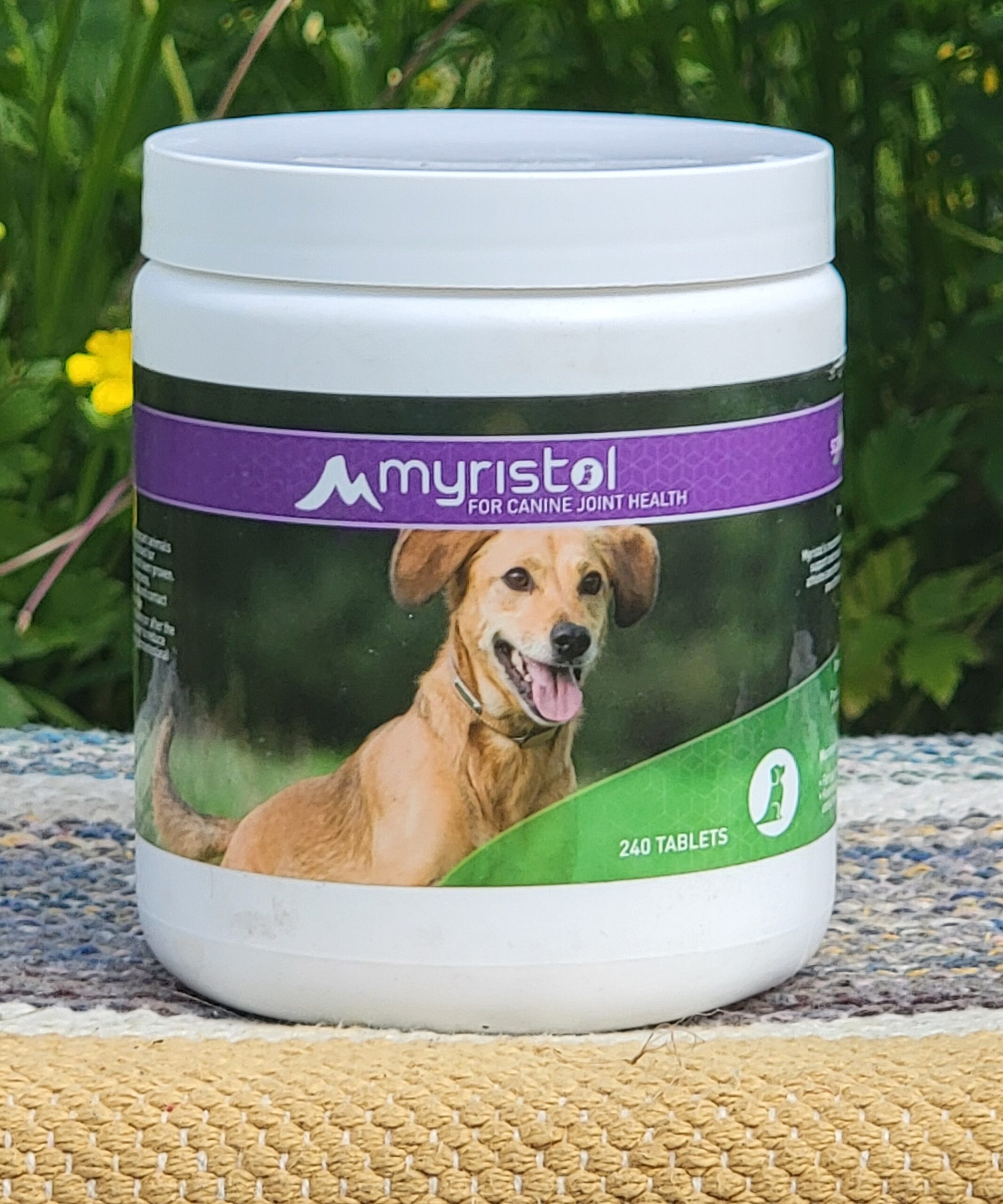
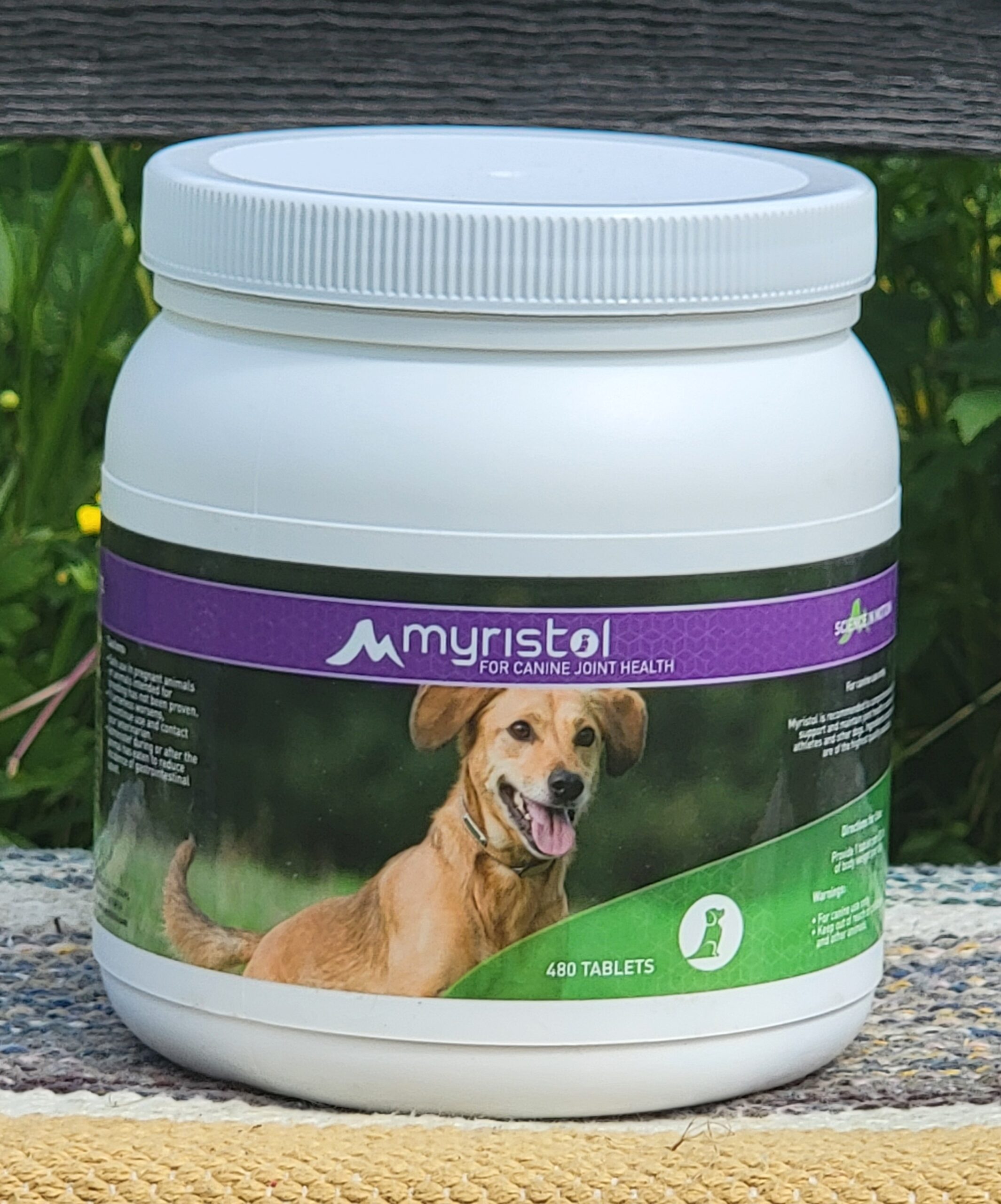


Myristol Canine
🇨🇦 Formulated in Canada by a Canadian veterinarian surgeon
Myristol is a complete joint support formula for dogs, developed by Dr. Gayle Trotter, an internationally recognized joint surgeon and researcher. Joint pain is really two problems at once: cartilage wearing down, and the inflammation that builds around it. Most supplements only address one. Myristol was formulated to work on both, combining cetyl myristoleate, the inflammation-side ingredient most formulas leave out entirely, with glucosamine, MSM, and hydrolyzed collagen for cartilage structure, all in one properly dosed tablet.
It is built for dogs that work, compete, and play hard, for breeds prone to hip and joint trouble and for senior dogs already slowing down. The best time to start is before the wear shows up.
✓ Dosed by body weight, no guesswork
✓ Eight active ingredients, dosed correctly in one tablet
✓ Helps build strong joints and mitigate inflammation
✓ Costs as little as 54 cents per day for a 30 lb dog
Price range: $69.00 through $174.00

Formulated with a proprietary complex and premium, research-informed ingredients. Every tablet is backed by our satisfaction guarantee.
Joint Pain Isn’t One Problem. It’s Two.
Whether you are running a dog through weave poles every weekend, working long days in the field, or raising a breed known for hip and joint trouble down the road, joint health is not something you want to start thinking about after the problems show up. The dogs that stay sound, mobile, and performing at their best for their whole lives are usually the ones whose joints were supported long before anything went wrong. To understand why that early support matters so much, it helps to know what is actually happening inside a joint when it starts to fail. In most cases there are two things going on at once, and both of them need attention.
Joint Structure
The first is structural. Every jump, sprint, sharp turn, and long day of work puts load on the cartilage, and some breeds are simply built with joints that wear faster than others. Cartilage also has very little ability to repair itself once it is damaged, which is exactly why supporting it early matters so much more than trying to rebuild it later.
Inflammation
The second is inflammatory. As stress and friction build up inside a joint, the body responds the same way it responds to any irritated tissue: it sends inflammation to the area. That inflammatory response is what actually produces the swelling, stiffness, and soreness that slow a dog down.
Most joint supplements are built to address only one of these problems. Structure focused formulas concentrate on protecting cartilage, while inflammation focused products concentrate on calming soreness. Myristol was formulated to work on both at the same time, because a dog that trains, works, and competes is putting demands on both sides of the joint, every single day.

The Science Behind The Blend

Myristol was not created by a supplement company looking for a product. It was formulated by Dr. Gayle W. Trotter, an internationally recognized equine surgeon and researcher who served on the faculties of Michigan State University and Colorado State University, and co-edited “Joint Disease in the Horse,” the preeminent textbook in the field. After a career focused on lameness, joint surgery, and joint disease, Dr. Trotter founded Myristol in 2003 to build the supplement that decades of clinical experience said should exist. Every ingredient in the blend is there for a specific reason, and it starts with the one most other formulas skip entirely.
Cetyl Myristoleate: The Ingredient Most Formulas Leave Out
Cetyl myristoleate is a fatty acid compound first identified by a researcher at the US National Institutes of Health, who was studying a strain of lab mice that never developed arthritis no matter how researchers tried to induce it. The compound he isolated from those mice was cetyl myristoleate. Research since then suggests it works on the inflammation side of joint pain, helping to quiet the inflammatory pathways that produce the swelling, stiffness, and soreness a dog actually feels.
This matters because inflammation support is the piece missing from most joint supplements on the shelf. Walk down any pet store aisle and you will find dozens of chews built on glucosamine, chondroitin, and MSM. Almost none of them contain cetyl myristoleate. It is the centerpiece of the Myristol blend, and it is the reason the formula addresses both sides of joint pain instead of one.
Glucosamine and MSM: Better Together, And The Research Proves It
You may have heard that glucosamine does not work. That claim comes from real research, including a large 2006 clinical trial where glucosamine taken on its own performed no better than a placebo.¹ But newer research asked a smarter question: what happens when it is combined with other joint supporting ingredients? Meta-analyses published in 2022 focused specifically on combination therapies found meaningful benefits that the old single ingredient trials never showed.²
The clearest example is a 12 week, randomized, double blind trial that split 118 osteoarthritis patients into four groups: glucosamine alone, MSM alone, the two combined, or a placebo.³ The combination group improved further and faster than either ingredient alone, and the researchers concluded that the pairing “provides better and more rapid improvement” than either one by itself. That is exactly how Myristol uses them: never alone, always together, at meaningful doses.
Hydrolyzed Collagen: The Raw Material Of The Joint Itself
Cartilage is largely made of collagen, so Myristol includes it directly in hydrolyzed form, which is broken into smaller pieces the body can actually absorb and use. The evidence here is unusually consistent for the supplement world. An analysis spanning 41 animal and human studies, including 25 clinical trials, found collagen supplementation benefited osteoarthritis and supported cartilage repair across doses, types, and brands.⁴
Dr. Trotter’s proprietary blend was carefully formulated with the right ingredients in the right doses, providing the building blocks for strong, healthy joints while helping keep inflammation in check, so your dog can recover faster, perform better, and feel their best.
What’s In Every Tablet
Eight active ingredients. One tablet per 20 lb of body weight, once a day.
Cetyl Myristoleate Complex
225 mg
The centrepiece of the blend. Supports the joint on the inflammation side, helping calm the swelling and soreness that slow a dog down. The ingredient most competing formulas do not include at all.
Glucosamine HCl
225 mg
Supplies the raw material the body uses to build the molecules that give cartilage its cushion and elasticity. Always paired with MSM in this formula, because that is how the research shows it works best.³
MSM
75 mg
A natural sulfur compound that supports connective tissue and contributes on the inflammation side as well. The proven partner to glucosamine.³
Hydrolyzed Collagen
225 mg
Cartilage is largely built from collagen. This supplies it directly, broken down into smaller pieces the body can actually absorb and put to work.⁴
Vitamin C
50 mg
The body cannot produce collagen without it. Included so the collagen in the formula, and your dog’s own collagen production, actually get used.
Zinc
1.0 mg
Supports tissue repair and the enzyme activity involved in maintaining healthy joints.
Manganese
0.5 mg
A required cofactor for the enzymes that build cartilage. Small amount, specific job.
Copper
0.2 mg
Helps cross-link collagen fibres, which is what gives connective tissue its strength.
The Right Time To Start Is Before They Need It
Cartilage has almost no ability to repair itself once it wears down. That single fact should change how you think about joint supplements. Waiting for stiffness to show up means waiting until some of the damage is already permanent, and no supplement on earth rebuilds what is fully gone. The dogs that stay sound into their senior years are almost always the ones whose joints were supported from the beginning. That is why Myristol is formulated to be started early and fed daily for life, whether your dog is a weekend athlete, a working partner, or a puppy from a breed with a known history of hip and joint trouble.
For Performance And Working Dogs
Agility runs, flyball, dock diving, herding, long days in the field. Sport and working dogs load their joints harder in a single weekend than most dogs do in a month, and they do it season after season. Myristol supports the cartilage taking that pounding and helps manage the inflammation that follows hard work, so your dog recovers faster between events and stays competitive longer. A shorter recovery is not just about comfort. It is more training days, more seasons, and a longer career doing what they love.
We interviewed Nicole Haueisen, who competes internationally for Canada’s National Agility Team with her dog, Reason, on her experience with Myristol. Watch her 2-minute story below!
For Breeds Built With A Weak Spot
German Shepherds. Labs and Goldens. Mastiffs, Great Danes, and most large and giant breeds. If you own one of these dogs, you already know what tends to happen to their hips and joints, because it is written into the breed. That predictability is actually an advantage. When you know the problem is likely coming, you can get ahead of it instead of reacting to it. Starting Myristol young gives these breeds daily structural support through their whole development and adult life, during all the years when protecting cartilage still matters most.
For Senior Dogs And Dogs Already Slowing Down
Maybe you are not here early. Maybe your dog is already taking the stairs a little slower, hesitating before jumping into the truck, or getting up stiff after a nap. Myristol still has a real job to do. The formula supports the cartilage your dog still has while helping calm the inflammation that causes most of the day-to-day soreness, which is often the piece that makes the biggest difference in how an older dog moves and feels. Plenty of Myristol dogs started at ten years old. The best day to start was years ago, and the second best day is today.
Frequently Asked Questions
See What Our Customers Are Saying
We have been using Myristol for approximately 3 years. We first started giving it to our oldest Border Collie Abby when she was 12 as she was becoming arthritic and would limp quite badly when she got up from her bed. After about 3 to 4 weeks we noticed a great improvement in her mobility and she continued to improve to the point where she didn’t limp at all. She is now 15 years old and is as spry as ever.
We also started giving Myristol to our Golden Retriever Luke when he developed an egg sized lump on his front foot and began to limp. Even though he was only 6 years old at the time, it was diagnosed as arthritis. After a month of taking Myristol the lump was significantly reduced and the limping was gone. Luke is now 8 and shows no signs of slowing down.
We have recommended Myristol to some of our friends and boarding customers whose dogs showed signs of soreness due to arthritis and they have had similar results.
This is Taz (Okies Sharp Gameplan) he is 12 this year and has benefited greatly from Myristol supplements! He has very sticky stifles and gets injections usually annually. I find this prolongs the injections and overall just assists him with feeling and working his best! It is very palatable and he eats them up no problem. I will be starting my 5 year old on the Myristol PRO this year as well as both of my horses receive the hemp oil and they look fantastic throughout the year! Thank you for repping and supplying us with a fantastic product! I firmly believe in it
Research Citations:
- Clegg DO, Reda DJ, Harris CL, et al. Glucosamine, chondroitin sulfate, and the two in combination for painful knee osteoarthritis. New England Journal of Medicine. 2006;354(8):795–808. doi:10.1056/NEJMoa052771. https://www.nejm.org/doi/full/10.1056/NEJMoa052771
- Meng Z, Liu J, Zhou N. Efficacy and safety of the combination of glucosamine and chondroitin for knee osteoarthritis: a systematic review and meta-analysis. Archives of Orthopaedic and Trauma Surgery. 2023;143(1):409–421. doi:10.1007/s00402-021-04326-9. https://pubmed.ncbi.nlm.nih.gov/35024906/ — and — Wang Z, Wang R, Yao H, et al. Clinical efficacy and safety of chondroitin combined with glucosamine in the treatment of knee osteoarthritis: a systematic review and meta-analysis. Computational and Mathematical Methods in Medicine. 2022;2022:5285244. doi:10.1155/2022/5285244. https://pubmed.ncbi.nlm.nih.gov/35924114/
- Usha PR, Naidu MUR. Randomised, double-blind, parallel, placebo-controlled study of oral glucosamine, methylsulfonylmethane and their combination in osteoarthritis. Clinical Drug Investigation. 2004;24(6):353–363. doi:10.2165/00044011-200424060-00005. https://pubmed.ncbi.nlm.nih.gov/17516722/
- Martínez-Puig D, Bruyère O, et al. Role of collagen derivatives in osteoarthritis and cartilage repair: a systematic scoping review with evidence mapping. Rheumatology and Therapy. 2020;7(4):703–740. doi:10.1007/s40744-020-00240-5. https://pubmed.ncbi.nlm.nih.gov/33068290/